


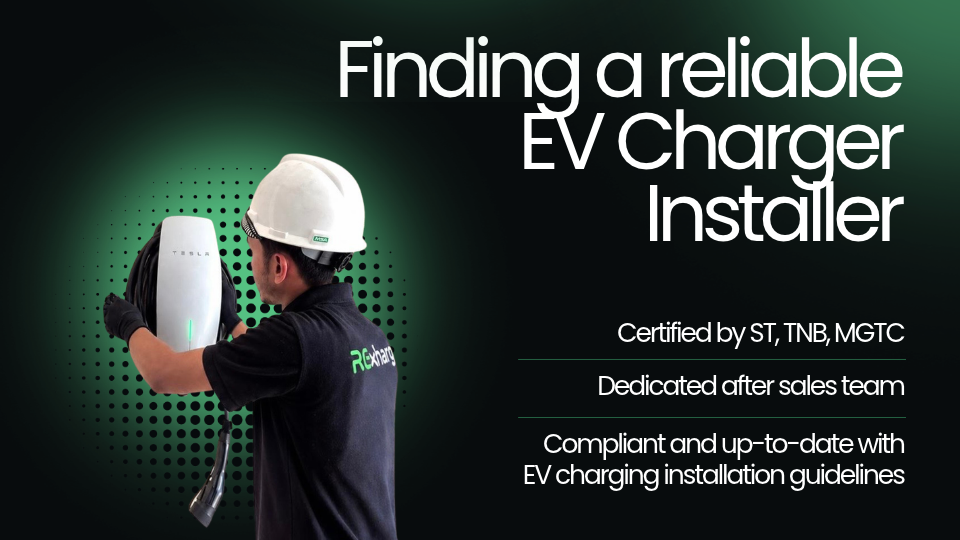
A home EV charger draws a heavy, steady load for hours at a time, often at night while the home owners are asleep. That makes the installer just as important as the quality of charger. A good EV charger installation is safe, reliable, compliant, and convenient for the EV owner.
Use this 10-point checklist before you decide on any EV charger installer in Malaysia.
1. Registered with Suruhanjaya Tenaga (Energy Commission)
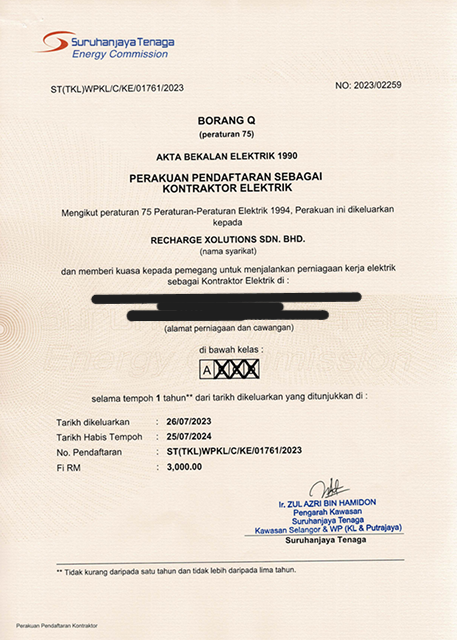
TNB advises using a wireman or electrical contractor registered with Suruhanjaya Tenaga. Ask for the contractor’s registration class and the wireman’s competency certificate. RExharge holds a Class A contractor registration and PW4 wireman certification.
2. A site assessment before the quote
A reliable installer checks your distribution board, cable route, phase and total household load before quoting a fixed price. A quote given over the phone without photos or a visit is a guess.
3. Responsible load calculation
The EV charger should be made to fit your home and your current usage. One can have an EV charger installed at their home with single-phase supply when the total household load, including the charger, stays within about 10 kW (up to about 50 amperes). Above that, you may need a three-phase upgrade from TNB which can cost around RM4,000 to RM9,000. A good installer explains your available options, instead of selling you the most expensive upgrade.
4. A dedicated circuit for the charger
The charger must have its own circuit with correctly sized cable and protection. It should never share a circuit with your aircon or water heater.
5. The right RCCB
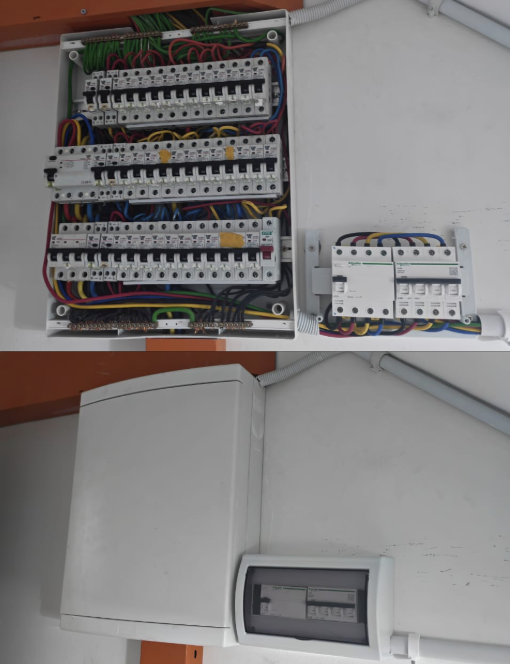
The RCCB is a residual current circuit breaker, a crucial electrical safety device designed to prevent fatal electric shocks and electrical fires by constantly monitoring the current balance between live and neutral wires. If a leakage occurs—such as when a person touches a live wire or an appliance develops an earth fault—the RCCB instantly detects the imbalance and cuts off the power within milliseconds.
TNB specifies 30 mA residual-current protection for EV charging, either Type A with DC fault detection or Type B, depending on the charger. Modern electronics—such as inverter air conditioners, computers, and EV chargers—convert AC power to Direct Current (DC). If a fault occurs in these electronic circuits, they can leak a pulsating DC residual current into the system. As the Type AC RCCB is unable to detect the pulsating DC leakage, it will not trip to protect you. See our RCCB upgrade case study, where a customer reportedly felt a shock while charging and we fixed the issue.
Most Cost-Effective & Preferred Solution: A Type A RCCB paired with a charger that has built-in DC protection.
Most modern smart chargers handle DC protection internally, allowing you to use a standard Type A RCCB. This is the go-to choice for landed homes because it fully meets TNB guidelines while keeping installation costs low.
6. An ST-SIRIM approved charger
Always ask for the charger’s approval label. The chargers RExharge supplies are typically IP65.
7. Cable sized for your charger’s appropriate output
Undersized cable is a common reason an EV charger only delivers a fraction of its rated speed. Moreover, it is a safety hazard because an undersized cable for an EV charger cannot safely handle sustained, high-amperage electrical loads. Our wiring upgrade case study shows a customer getting 3.7 kW from a 22 kW charger until the cable was replaced.
8. Testing and a commissioning report
After installation, a competent installer tests the circuit and gives you a testing and commissioning report. Keep it for your warranty and insurance records.
9. Written warranty for both product and workmanship
The charger warranty (product warranty) comes from the brand. Workmanship warranty comes from the installer. Get both in writing. The warranty is typically effective from commissioning date.
10. Real reviews and real after-sales support
Look for recent Google reviews that mention named technicians, tidy work and follow-up visits. Ask the installer who to call if the charger trips at 11pm. Recharge Xolutions has a dedicated after-sales team.
Red flags to walk away from
- No mention of the RCCB type
- Cash only, with no invoice (you need the receipt to claim EV charger tax relief)
Why Malaysian EV owners choose Recharge Xolutions
RExharge is a Suruhanjaya Tenaga Class A contractor with PW4 certified wiremen, TNB Gred 5 and MGTC MyHIJAU certification. We are an authorised installer for PROTON e.MAS through PRO-NET and for Tesla, have installed more than 8,000 chargers nationwide as of September 2026, and hold a 4.9-star average on Google.
WhatsApp us for a free site assessment
Frequently Asked Questions
Do I need TNB approval to install a home EV charger?
Not for the charger itself in a private home. You only apply to TNB if your supply needs upgrading, for example from single-phase to three-phase.
How long does EV charger installation take?
A standard installation takes about 3-4 hours on the day. Booking to switch-on is usually 5 to 10 working days, subject to site readiness.